Shoulder Injuries and Yoga: Urdvha Dhanurasana (Wheel Pose)

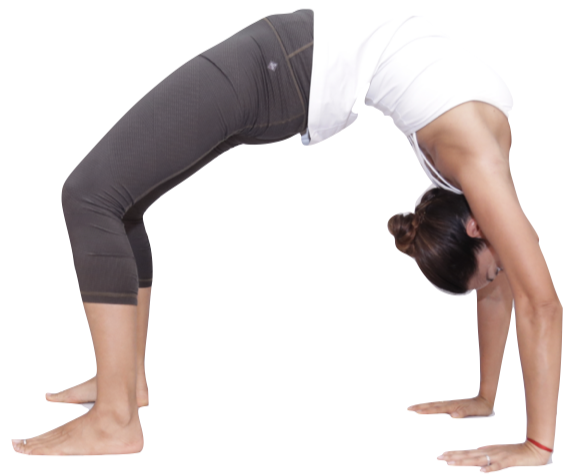
Image from Tara Mitra's Primary Series Chart

Recently I consulted with a dedicated yoga student with a 10-month history of shoulder issues. It had all started from yoga asana and had eventually led him to stop his practice. This is the kind of story that I never like to hear. 

His pain had started when pushing up into Urdvha Dhanurasana (wheel). Then he started noticing pain when stretching his arms overhead after Savasana. Then downward dog, Sirsasana, and jumping back/through (vinyasa). By this time, he was even feeling it during everyday movements.

His teacher told him it was just a "structural transformation" and that he needed to "work through the pain". Yes, these are the teacher's words. So he carried on until he got to a point where he just could not continue. His shoulder was really struggling. So he took a break from yoga, consulted different physios and, although it started to settle over the coming months was far from right.  

He got in touch with me a couple of days after consulting with an orthopaedic doctor. This doctor had suggested obtaining an MRI to try to establish what was going on.

Here are the findings from that MRI study:

  1. Partial tear of glenoid labrum - superior anterior-posterior (SLAP lesion)
  2. Mild bursitis - subacromion bursa, subdeltoid bursa, subcoracoid bursa
  3. Partial tear of the supraspinatus muscle tendon 
  4. A strain of infraspinatus muscle-tendon
  5. Sprain of glenohumeral ligament and coracoacromial ligament
Now, thats a lot going on right there! Even if you are not familiar with everything on this list, you will probably be clutching your shoulder, thinking that must hurt! 

(The images below will help you understand some of the structures listed above - taken from the Shoulder Course).
Figure above: The glenoid labrum surrounds the outer part of the glenohumeral joint.  Its main function is to seal and stabilise the joint.

Figure below:  There are 4 rotator cuff muscles: supraspinatus, infraspinatus, teres minor and subscapularis.  Together they help to position and stabilise the joint.  They are however vulnerable to injury and a common source of shoulder pain.
Appreciate that he had been resting the shoulder for months and having physio BEFORE this MRI was taken. Even with this, there was still a great deal of damage that was yet to repair.

It was a situation that could have been completely avoided.  So how do injuries like this develop?

Many injuries of the shoulder arise from repetitive strain. Movements were performed again and again. However, there will often be other factors involved that increase injury risk. These can include:

  • Poor endurance of stabilising muscles. With repetition of movement, these muscles become tired. As they do, faulty joint motion occurs that may stress and damage nearby tissues. 
  • Poor technique in the movement being performed, which detrimentally stresses the shoulder.
  • Poor upper body posture, including of the spine and/or shoulder. This again leads to faulty movement and abnormal stresses to it.
A well trained and knowledgeable teacher will know this. They will also know that if this has been considered and pain arises, they and the student need to step back. Reflect on what is going on, make changes, and/or seek outside help.  
Urdhva Dhanurasana is a challenging pose.  It requires hip, spine and shoulder mobility as well as strength.  As the shoulder is so mobile it can be easily overloaded and injured, as it compensates for a stiff spine or hips.  This is what I would speculate occurred with this student. 
As I often like to say, yoga is not wrong, but its application can be.

Th is a really important point. When injuries to occur in yoga, we should not say yogo is bad or postures are dangerous and should not be practiced.  At these times we must instead consider how it was applied and to whom it was applied. 
What will be the outcome for this student? The orthopaedic Dr has already suggested surgery. However, I believe it can be avoided with care and time. It will likely take 3-6 months and careful design and application of a movement therapy program, but I am confident it will improve. 

Each person with these types of injuries , or anyone with a shoulder issue, requires careful analysis to understand what needs to be done to help heal them.  This can include assessments of: 
Based on what is found specific therapeutic programs can be designed to improve damaged tissues and restore function.

Are you a yoga teacher and want to learn more about working with these types of injuries?  Then take a look at the Shoulder Course which covers the topics discussed here and so much more.

  • £199 or 3 monthly payments of £67

The Shoulder

  • 57 Lessons

In this 15hr course teaches you how to work with injuries, including rotator cuff & labral tears, instability & much, much more.

Struggling with a Shoulder Issue or Another Injury?

Consider an online consultation with me.